The Bridgeport Networks commerce platform is a production-grade, white-label payment and merchant environment engineered for bounded venues, territories, and events. It is not an app on top of legacy rails. It is the rail.
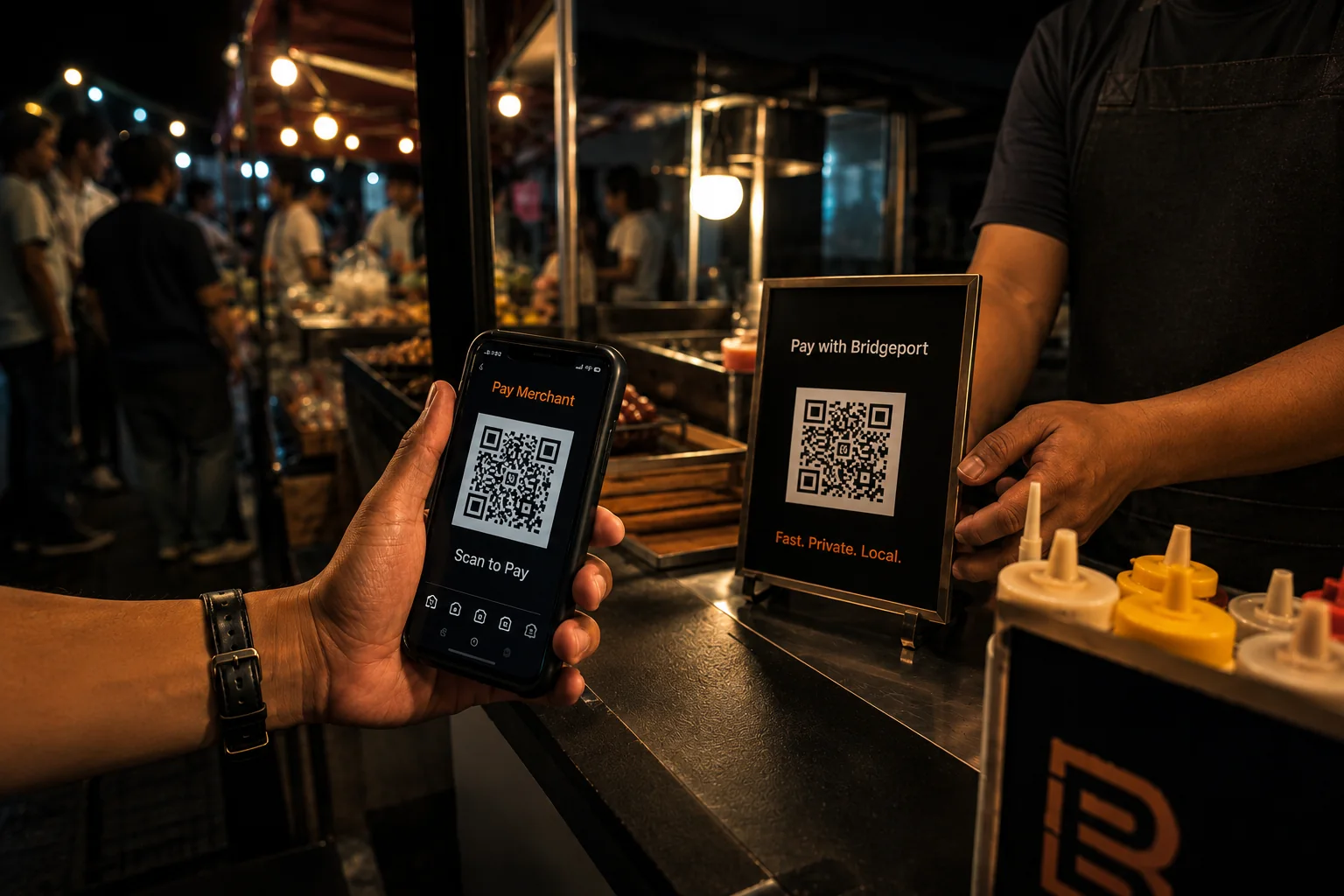
A closed-loop commerce platform that allows an operator — a venue, a host territory, an event promoter, a private community — to issue its own branded payment environment to merchants and consumers inside a defined perimeter.
Consumers fund a digital wallet under the operator's brand. Merchants accept payment via QR code or a payment link. Transactions settle in under five seconds at a single-digit fee, with the operator retaining full visibility into transaction flow, merchant performance, and consumer behavior. Funds clear without leaving the operator's ecosystem until cash-out, at which point the operator's banking and treasury arrangements take over.
The platform is fully rebrandable. The operator's name is on the consumer wallet. The operator's identity is on the merchant terminal. Bridgeport Networks operates beneath the surface as the platform — the technology, the codebase, and the operating framework — while the operator owns the customer-facing experience end to end.
A branded consumer wallet — accessible by mobile browser or installed application — that holds value inside the operator's commerce environment. Consumers fund the wallet by card, bank, on-site kiosk, or cash agent depending on the licensee's configuration. No hardware is required to participate.
Merchants accept payment by displaying a static or dynamic QR code or by sending a payment link. The merchant device can be any smartphone, tablet, or terminal already in their possession. No dedicated POS hardware needs to be issued, deployed, or maintained.
Transactions clear merchant-to-consumer in under five seconds. Settlement to the merchant's funding account follows on a cadence determined by the licensee — same-day, next-day, or batch — and is independent of legacy card-rail processing windows.
An embedded rewards layer issues a branded credit on every transaction. The operator defines the conversion ratio, the redemption rules, and the on-platform utility. Rewards become a closed-loop currency that drives repeat consumer activity inside the operator's environment.
The operator receives a private analytics dashboard exposing transaction volume, merchant performance, consumer flow, category-level spend, and time-of-day patterns. The data layer belongs to the operator and is not shared, syndicated, or resold to third parties.
Compliance, fraud surveillance, dispute handling, and merchant approval are exposed to the operator through an administrative console. The operator retains discretion over merchant onboarding criteria, transaction limits, and consumer behavioural policies inside the perimeter.
Bridgeport Networks does not operate commerce environments directly. Each deployment is conducted under license to a local operator who carries the merchant relationships, the regulatory standing, and the commercial reach inside their territory or venue.
The platform, the underlying codebase, and the integration architecture.
Configuration and deployment for the licensee's branding, merchant taxonomy, and operating parameters.
Ongoing platform engineering, security maintenance, and capability development.
Operator support, technical onboarding, and analytics-tooling access.
The market — the venue, the territory, the perimeter, the consumer base.
Merchant relationships and onboarding inside the bounded environment.
Local regulatory standing, banking relationships, and compliance posture.
Commercial control over branding, consumer-facing experience, and on-platform economics.
The commerce platform is purpose-built for bounded environments with high transaction density and operator-controlled consumer flow. The deployment pattern is consistent across verticals; the surface area changes.
Three- to five-day events with 100,000 to 300,000 attendees. Vendor ecosystems, hospitality programs, and merchandise. Operator demand for spend analytics is acute and largely unmet by conventional rails.
Multi-day festivals with embedded vendor markets, RFID and wristband integration, and pre-loaded wallet flows. Operator analytics and cashless throughput are commercial requirements, not luxuries.
Stadium tours, single-venue residencies, and seasonal performance runs. Compressed deployment window, contained venue, full operator branding from launch.
Cruise port environments with captive shore-excursion spend, day-of-call merchant ecosystems, and recurring vessel cycles that compound over an operating season.
Tourism-driven resort districts where conventional payment rails are fragile, fragmented, or culturally underused. Closed-loop commerce solves both the throughput and the local-economic-flywheel problem simultaneously.
Defined perimeters with closed merchant networks and recurring populations. Operator branding on the consumer wallet creates retention; campus economics become legible and manageable.
Country clubs, yacht clubs, residence clubs, gated developments. Closed economies where members already operate under a single billing relationship — the commerce platform makes that relationship native.
Golf majors, tennis events, regattas, esports finals. Multi-day, fixed-perimeter, hospitality-heavy environments with operator-branded consumer programs.
A payments app is not infrastructure. Infrastructure is what you deploy when you control the perimeter, the merchants, and the data layer beneath them. — Platform Posture